
Genesis of the Framework
My sales career spanning over 15 years started with multi-billion dollar organizations that taught me everything about sales. This was followed by my stints at DigitalOcean & QuantWare where I got a chance to deploy my learnings. While scaling the sales & GTM teams at these 2 organizations, there was something going on in the back of my head – is this something that can be repeated elsewhere? What are some of the common steps? What are the common challenges? How can startups reduce the risk of failure and move fast? Thus was born the 021 Playbook Framework.
Steps of the Framework
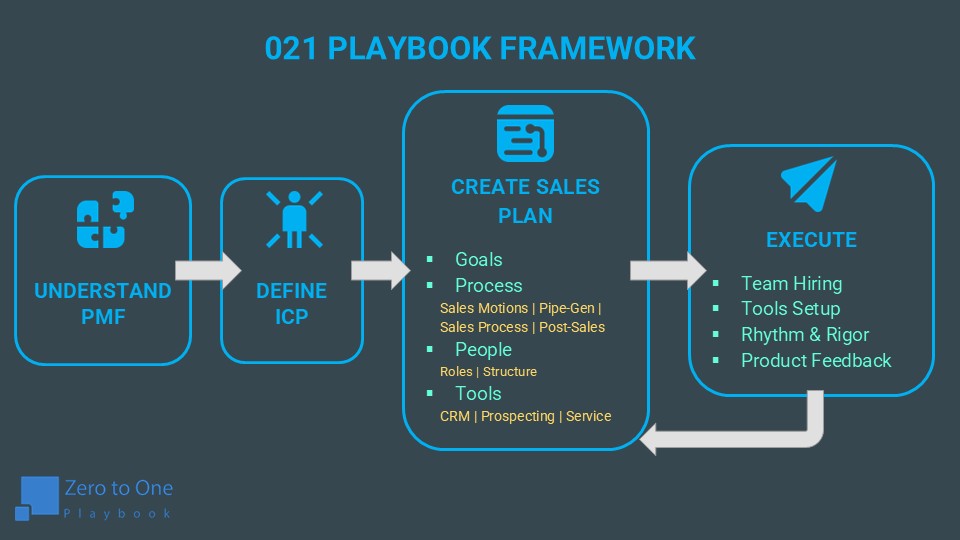
The best way to understand the framework is to list down the steps
Step 0: Understand PMF
PMF (Product-Market Fit) is a pre-requisite for the playbook. It fuels everything to follow. Without PMF, a playbook doesn’t make sense. Startups that are yet to find PMF are NOT ready to craft & deploy their playbook.
“Without PMF, a playbook doesn’t make sense.”
Listing down each of the 3 letters of the words is critical and drives clarity within the founding team.
P for Product – What is the product/offering of the company? What problem does it solve? What are the alternatives today?
M for Market – Who are the initial customers, where did they come from, what was their pain point?
F for Fit – How well is the product aligned w the market, are any other products required, how about pricing, what does the competition look like?
The best way to answer all of these is through a customer interviews & a PMF workshop.
Step 1: Define ICP
The very first step of the Playbook is the ICP which stands for Ideal Customer Profile. Based on the Step 0 exercise and answers you receive, you should be able to draft a very clear picture of what your ideal customer should look like. You are talking about the company profile at this stage – which industry, which geography, what segment, what size, any specific profile features?
Based on the ICP, you also define the Personas within that ICP that you want to go after – is it the developer, CTO, CIO, VP Sales, etc. that you are going to sell to.
Note – Sometimes your product might be such that the Persona is leading – eg. if you are building an AI Audit software that is going to help the CFOs, then you already know your Persona first before you define your ICP.
ICP Definition is the most critical step as this will determine everything you do downstream – so its worth spending quality time on this. This should also drive clarity within the company.
“ICP Definition is the most critical step of the Playbook”
Step 2: Create Sales Plan
Once you have the ICP defined and crystal clear in your heads, everything can now start taking shape. Sales Planning is the “Thinking Step” of the playbook.
“Sales Planning is the ‘Thinking Step’ of the playbook.”
Goals – Together with the ICP, your goals will drive the sales plan – is your goal to show traction through pipe-gen OR create specific revenue/sales OR raise funds? How does that goal break down into number of customers and ASP (Average Selling Price)? What is the timeline breakdown?
Sales Motions – Define what is the best way to reach these target customers – inbound vs outbound vs channel or a combination of all three?
Pipe-Gen Process – Based on the sales motions, you will determine how you are going to generate the leads and the pipeline – if the sales motion is inbound leaning, then you need more marketing push vs if its outbound leaning, you need to have a sales-led approach.
Sales Process – Once the lead is generated, how is the team going to bring that lead to closure? How do you define closure? What happens post-close?
Post-Sales Process – How are you going to create a great customer experience and create upsell and cross-sell opportunities.
People – Based on your choice of sales motion, define the roles you need to execute – marketing folks vs SDR/BDR/AE vs Channel sales
Tools – Finally, what tools will be needed to make the team successful in achieving the goal. At the very minimum, you’ll need a CRM system, but everything else will be based on the motions you are selecting.
Step 3: Execute
That’s it! You are now ready to execute – you have the plan that the people need to execute. Sales Execution is the “Do Step” of the playbook.
“Sales Execution is the ‘Do Step’ of the playbook.”
Start hiring, setup the sales stack and put the rigor and rhythm in place. Break down the goal into daily activities and goals. You’ll make several assumptions along the way. Your objective is to validate and invalidate these assumptions as quickly as possible. Execute fast, learn fast and run short experiments at first to see what’s working and what’s not.
Establish Feedback Loop
In practice, your Step 2 and Step 3 will be continuously feeding into each other – what you learn in the field needs to come back to the planning board which should then create a different execution method.
It is also critical for a startup to have the sales team feed continuously into the product team. In a startup, everyone is a salesperson. From the CEO to the intern – from product & engineering to customer success – everyone needs to hear the customer’s voice from the sales team.
“In a startup, everyone is a salesperson.”
Use this feedback from the field to improve your process, product and practices. Setup a rhythm (fortnightly/monthly/quarterly) to review the sales plan and execution.
Final Remarks
The framework is exactly what it is – a framework. It is not your playbook – each company is unique and needs its own playbook. The framework is there to help guide the process of creating the playbook.

 Zero to One Playbook
Leave a comment